
You can always tell when something big just happened in world politics. The usual suspects start wringing their hands and asking the same question:
“What gives the United States the right to decide what Iran can or can’t do?”
Ah yes. The question that sounds very deep until you think about it for about three seconds.
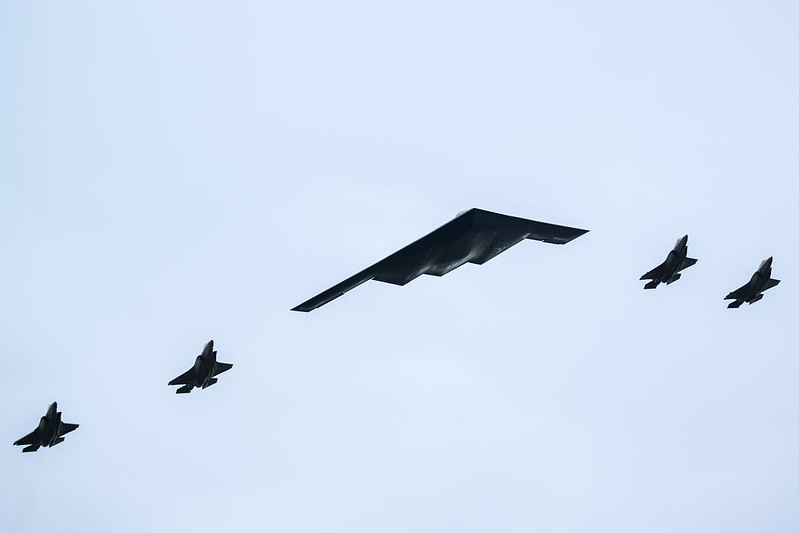
The short answer? Power. The long answer? The B-2 bomber.
Not Democrats. Not Republicans. Not a UN resolution. Not a think tank white paper. Not a sternly worded letter from some global committee.
Power.
For roughly 80 years, the United States has been the dominant military power on planet Earth.
That’s the real international order. Everything else is window dressing.
And right now that dominance is exactly why Iran’s nuclear ambitions are being stopped.
Because when the strongest nation on Earth decides something is unacceptable, weaker regimes don’t get to hold a vote about it.
One of the people you’ll hear in the first clip is Dr. George Szamuely, a senior research fellow at the Global Policy Institute, who’s upset that the United States declared Iran’s uranium program unacceptable before the strike this weekend. In his view, America doesn’t get to make that call. Journalist Will Chamberlain responds by explaining a rather simple reality of world affairs — the country with the power usually does.
Szamuely: "Iran has the right to enrich uranium up to 3%!"
Me: "Call the international law police and send them to the White House, no one cares."pic.twitter.com/m6GFytAlGy
— Will Chamberlain (@willchamberlain) March 3, 2026
The uncomfortable truth many people don’t want to admit is this: international law ultimately rests on the willingness of powerful nations to enforce it. Diplomacy works because power backs it up. Treaties work because someone can enforce them.
"What gives the US the right to decide whether or not Iran can enrich uranium?"
"The B2 bomber."
"So might makes right?"
"Yes."
Based. https://t.co/ZYArNpC6Ce
— Ian Miles Cheong (@ianmiles) March 3, 2026
The strong set the rules. The weak adjust to them.
And for decades, that role has belonged to the United States.
https://t.co/f0rN9fjEHr pic.twitter.com/QlQ0w4V3Nb
— Frontierism (@frontierism) March 4, 2026
Now, enter the latest round of outrage—from a handful of newly minted populist conservatives who suddenly decided President Trump’s strike on Iran crossed some imaginary line. I.E. the Tucker Carlson crowd.
These are the same people who spent years acknowledging that Iran is a dangerous regime. They’ve said repeatedly that Iran can’t be allowed to develop nuclear weapons or long-range missiles capable of hitting American allies.
But the moment Trump actually did something about it, they started threatening to leave the Republican Party.
I voted for Trump. I won’t be voting again. Many young conservatives feel the same way.
We’re sick of this shit.
— JuliansRum (@ItsJuliansRum) March 2, 2026
Seriously?
You can’t spend years saying Iran is an existential threat and then panic when the United States uses the very power that keeps that threat in check.
That’s not principled conservatism. That’s geopolitical naïveté.
I’m mad because somebody didn’t do every single thing I wanted so now I’m going to standby and let the race communists open our borders because I am mad. https://t.co/Thc1GIfVg8
— Kurt Schlichter (@KurtSchlichter) March 3, 2026
The Republican Party has always understood something basic about global stability: peace comes through strength. It always has.
From Reagan confronting the Soviet Union to the Gulf War to counterterrorism operations after 9/11, American strategy has rested on the same principle: hostile regimes don’t get to build weapons capable of threatening the United States and its allies.
President Trump didn’t invent that doctrine. He’s enforcing it.
You can whine and gripe all you want—because patriots fought and died to give you that right.
But if you think abdicating your sacred duty to vote won’t make it worse, you’re a fool.
You’d also be voting by default for the Democrats—which makes you a fool supporting pure evil. https://t.co/PVz9wUgiMm
— John Strand (@JohnStrandUSA) March 3, 2026
In fact, if anything, Trump has spent the last several years strengthening the very military capabilities that make that doctrine credible. His administration has focused heavily on rebuilding readiness, increasing ammunition production, modernizing weapons systems, and ensuring U.S. forces remain the best trained on the planet.
That matters.
Because dominance only works if your adversaries believe you’re willing—and able—to use it.
You people are so dumb. You have no idea how bad it was before Trump. Likely how bad it will be after he’s out of the picture.
We are so lucky he decided to run and run again and again. https://t.co/9946dOCPRN
— WatchtowerWest (@watchtower1683) March 2, 2026
And make no mistake: no other country on Earth can match the United States militarily. China isn’t there yet. Russia certainly isn’t. Iran isn’t even playing the same sport.
That’s why the idea that some international committee gets to decide whether America can act is so absurd.
The UN doesn’t enforce global order.
The United States does.
For generations, America has been the stabilizing force that prevents dangerous regimes from rewriting the global balance of power.
Countries that don’t like it are welcome to challenge that reality.
But so far, none of them have. And none of them are likely to anytime soon.
Because the truth is simple—and the entire world knows it.
When the big dog sets the rules, everyone else pays attention.