

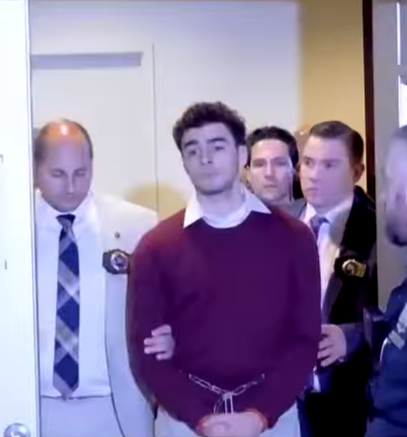
A federal judge just made a big decision in a case that has shaken the country. Luigi Mangione, the man accused of murdering Brian Thompson, the CEO of UnitedHealthcare, will no longer face the death penalty. This ruling is surprising, especially considering the murder was caught on tape by surveillance cameras.
The murder happened on December 4, 2024, in Midtown Manhattan. Thompson was walking to a hotel for a company event when he was shot from behind. He left behind a wife and two young kids. Shell casings were found at the scene, and they had the words “delay,” “deny,” and “depose” written on them. These words come from a book that attacks the health insurance business. That’s where Mangione’s motive may come from.
Mangione was tracked down and arrested five days later in Altoona, Pennsylvania. Cops found him at a McDonald’s with a backpack. Inside that bag, they found a gun, a silencer, and what looked like a manifesto. The notebook inside had language about planning to “whack” the CEO at what he called a “parasitic bean-counter convention.” That doesn’t sound like a simple misunderstanding. It sounds like a planned hit.
Attorney General Pam Bondi had ordered federal prosecutors to go after the death penalty. That made sense. This was not a crime of passion. It was a pre-meditated act to kill a man. But now, U.S. District Judge Margaret Garnett has said the death penalty is off the table.
Why? Because the charge that allowed the death penalty—“using a firearm to commit murder in furtherance of a crime of violence”—has legal problems, according to the judge. She agreed with Mangione’s defense team and said that stalking, which was part of the charge, isn’t technically a “crime of violence.” The judge said that violence means using force, and stalking can happen without force.
Mangione still faces life in prison without parole, which is something. But life in prison is not the same as the death penalty. A man who plans and carries out a political-style assassination should not get to live out his days on the taxpayer’s dime. And yet, that’s where we are.
At least the judge made one good call. She allowed the evidence from Mangione’s backpack to be used in the trial. His team argued that the police didn’t have a warrant, but the judge said there are exceptions—especially when a weapon is found. That evidence, including the gun and the notebook, could be key to getting a conviction.
Mangione has pleaded not guilty, and the trial is set to begin in October. Jury selection starts in early September. Meanwhile, his supporters are out there calling for more killings of healthcare executives. That’s sick and dangerous. No matter what you think about the healthcare system, murder is never the answer.
This case is a reminder that our justice system doesn’t always deliver what it should.



![EPA Head Lee Zeldin Smacks Down Democrat with FACTS Over Climate Change [WATCH]](https://www.thebeardedpatriot.com/wp-content/uploads/2026/04/tmp7539j6qu.jpg)