

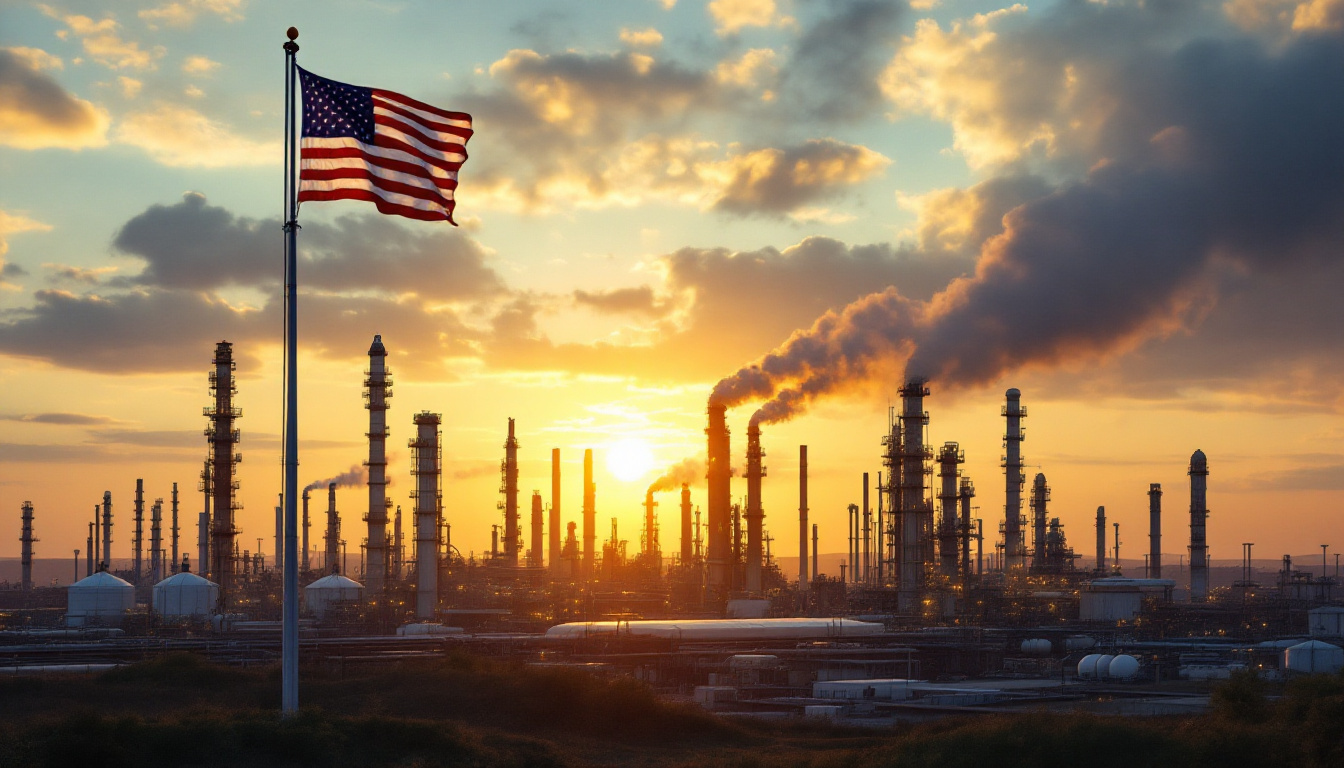
President Trump signed a Presidential Determination memo on October 22 directing War Secretary Pete Hegseth to invoke the Defense Production Act of 1950 to expand domestic oil production. The Department of Defense will release $150 million to fund the effort.
The same Cold War law Biden used to manufacture solar panels is now pumping petroleum to bring down the price of gas.
The Defense Production Act was designed to let the federal government fast-track production of materials deemed essential to national security. During the Cold War, that meant weapons systems and strategic metals. Biden stretched the statute to cover solar panels, heat pumps, and electric grid components — green energy priorities repackaged as defense needs. Trump's memo makes the opposite case with considerably less creative interpretation.
"Petroleum fuels the Nation's Armed Forces, industrial base, and crucial infrastructure," Trump wrote in the determination. That's not an argument. That's a statement of mechanical fact. Jets burn fuel. Tanks burn fuel. The ships keeping global trade lanes open burn fuel. The Act was written for exactly this kind of supply chain.
The memo authorizes Hegseth to make purchases and financial commitments aimed at expanding petroleum infrastructure, with specific focus on increasing refining capacity for diesel and gasoline production. The $150 million from the Pentagon isn't a subsidy for oil companies — it's a defense appropriation aimed at making sure the military's supply chain doesn't depend on foreign production decisions.
Trump announced the move during a speech in Iowa, framing it as a direct national security action.
"Without immediate Federal action, United States defense capabilities will remain vulnerable to disruption," he wrote in the memo. Refining capacity has been a quiet pressure point for years. No new major refinery has been built in the United States since the 1970s, and several have closed or converted to biofuel processing under regulatory pressure. The capacity that remains runs hot, which is why gas prices spike every time a refinery goes down for maintenance or a hurricane clips the Gulf Coast.
The Biden administration used the Defense Production Act to accelerate production of clean energy components in 2022, arguing that climate change constituted a national security threat. The legal framework was identical — the president determines a material is essential to defense, and federal dollars flow to expand production. The difference is what you consider essential. Biden picked solar panels. Trump picked the fuel that actually moves the military.
Rebuilding refining capacity doesn't show up at the pump next week. But every barrel refined domestically is a barrel that doesn't depend on OPEC scheduling decisions or foreign policy calculations in the Middle East. The strategic logic is straightforward: if petroleum is the literal fuel of national defense, treating its domestic production as a defense priority isn't a stretch of the statute. It's the original intent.