
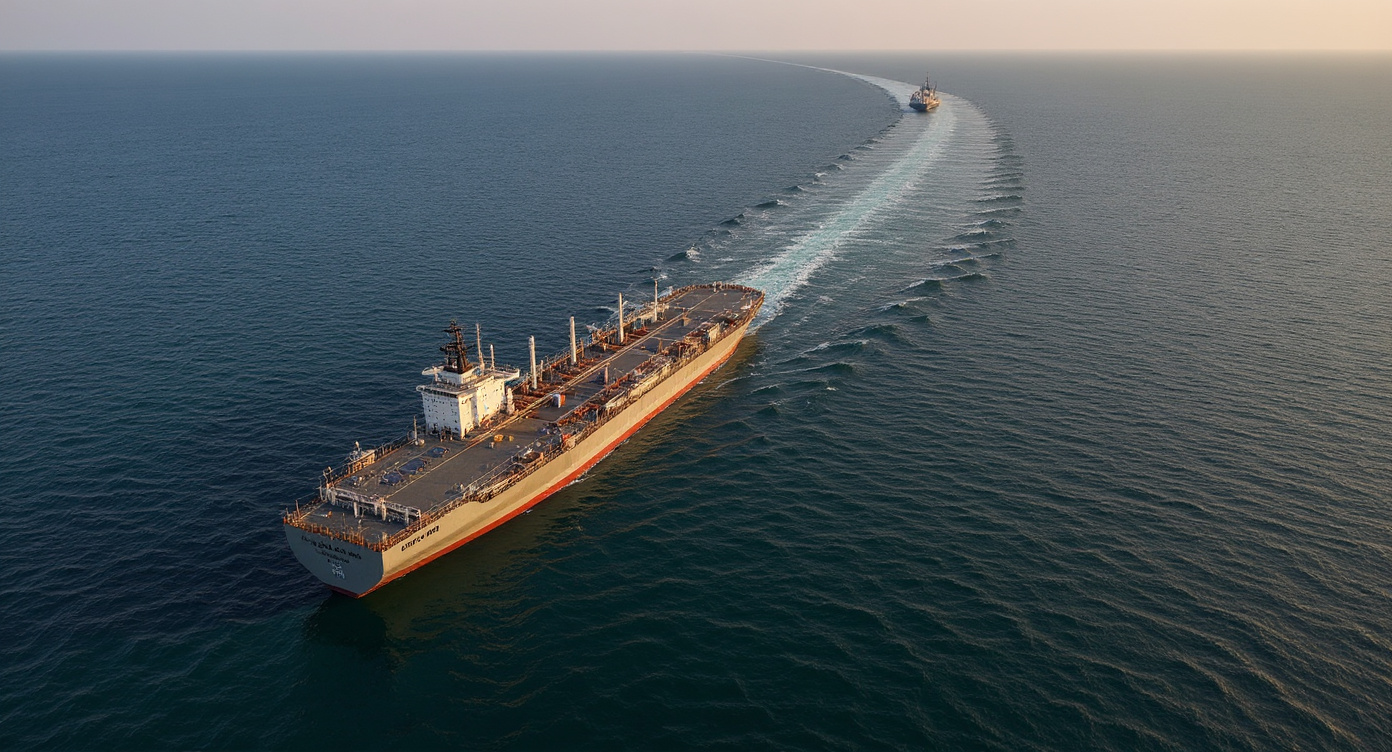
Twenty percent. That's the cut President Donald Trump just announced the United States will take on every piece of cargo that passes through the Strait of Hormuz — the narrow chokepoint where roughly 20 million barrels of oil move every single day, accounting for about 25% of the world's maritime oil trade.
The man just invented a toll booth in the middle of the ocean.
Trump posted on Truth Social Monday that "The U.S.A. will be, from this point forward, known as 'THE GUARDIAN OF THE HORMUZ STRAIT,' but as such, and as a matter of FAIRNESS, will be reimbursed, at the rate of 20% on all cargo shipped, for any and all costs necessary to do the job of providing safety and security to this very volatile section of the World."
He wasn't done. In a separate post, Trump declared: "We are reinstating THE IRANIAN BLOCKADE, so named because it is only stopping Iran's ships or customers from entering or leaving." U.S. Central Command confirmed the blockade would go into effect Tuesday at 4 p.m. ET.
The background here matters. On June 17, Trump and Iranian President Masoud Pezeshkian signed a memorandum of understanding to end hostilities and lift the U.S. naval blockade. Tehran agreed it wouldn't charge tolls on the strait for 60 days. That deal lasted about as long as you'd expect a handshake with the mullahs to last.
Over the past week, the ceasefire disintegrated completely. Iran's IRGC launched strikes on Bahrain, Jordan, Kuwait, and Oman. The UAE reported incoming missile fire. The U.S. hit dozens of targets inside Iran. Iran responded. The U.S. responded to the response. Iran's foreign ministry spokesman Esmaeil Baghaei admitted Monday that the June framework deal was "in crisis." That's diplomat-speak for "it's dead."
So Trump did what Trump does — he didn't just reinstate the blockade. He monetized the strait.
"We guarded the strait for 50 years — more — and we never got paid for it," Trump said. "We guarded it for nothing, and now we're going to guard it and we're going to get paid for guarding it — a lot of money."
The International Maritime Organization immediately clutched its pearls. "IMO stands firmly against charging fees for passage through straits used for international navigation," the UN shipping agency stated. "There is no legal basis through which to introduce mandatory tolls simply to transit through a strait."
No legal basis. That's a fun argument to make to the country with the aircraft carriers.
Iran's joint military command issued its own statement, warning that "we will not, under any circumstances, allow the US to interfere in the management of the Strait of Hormuz." This from a regime currently getting its military infrastructure rearranged by U.S. Central Command on a nightly basis.
Oil prices jumped more than 9% on the news, which tells you everything about who actually controls this waterway. It's not the country issuing strongly worded statements from Tehran. It's the country with a naval fleet parked in the middle of it.
Here's what makes this interesting beyond the immediate fireworks. The Strait of Hormuz is the only maritime gateway to the Persian Gulf. Unlike the Strait of Malacca, there's no alternate route. Saudi Arabia, Iraq, Kuwait, the UAE, and Iran all export through it. Nearly 15 million barrels per day of crude oil transit through those waters — roughly 34% of all global crude trade, according to the International Energy Agency.
For decades, the U.S. Navy kept it open. American taxpayers footed the bill. The countries shipping billions in petroleum through it paid nothing for the service. Every president before this one accepted that arrangement as the cost of maintaining "global stability" — a phrase that translates roughly to "other countries get rich while we write the checks."
Trump looked at 50 years of free security and asked the question nobody in Washington ever bothered to ask: why?
The critics will say it's unenforceable. The allies will say it's provocative. The UN will cite maritime law written before aircraft carriers existed. Tehran will issue threats from a command structure that's running out of things to command.
Meanwhile, the strait is open. The blockade is back on Iran. And the toll booth has a new operator.