
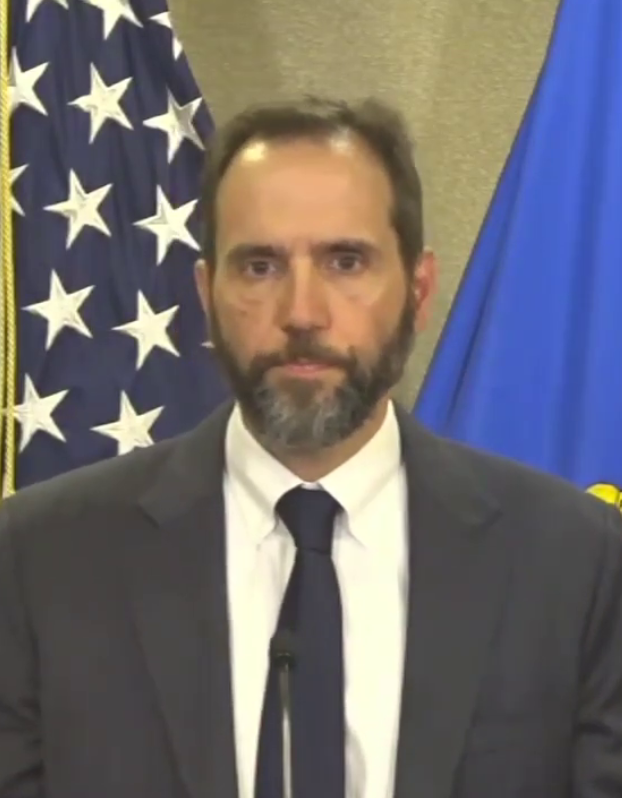
Dave Grohl pointed into the crowd at Merriweather Post Pavilion in Columbia, Maryland on Saturday night and dedicated a song to "my new friend Jack." The Jack in question was former Special Counsel Jack Smith, sitting in the audience at the Power to the People Fest — a Soros-funded concert headlined by Bruce Springsteen — wearing a Springsteen tour shirt that read "No Kings" across the front. It's a White Dudes for Kamala t-shirt.
Five days earlier, Smith was sitting in a very different chair, testifying before the Senate Judiciary Committee about the scope of his investigations into Donald Trump and his supporters.
The photos show Smith at the October 3rd festival looking relaxed in the "Bruce Springsteen & E Street Land of Hope and Dreams American Tour No Kings" shirt. A companion was photographed wearing a shirt featuring a quote from Indiana Jones: "Nazis… I hate these guys." The Power to the People Fest — bankrolled by leftwing billionaire George Soros — also featured performers Macklemore, Joan Baez and Tom Morello, and was explicitly designed to mobilize Democratic voters ahead of the midterms.
Smith's appearance at the festival landed days after journalist Catherine Herridge reported on the revelations from his September 29th Senate testimony. Her assessment was blunt: "Big takeaway is that the investigations by Jack Smith were much broader and more sweeping than most Americans realize."
How broad? Smith's team gathered the financial information of roughly 5,000 Americans — Republican donors whose only crime was contributing to Trump's campaign. We're not talking about whales writing six-figure checks. The donations in question included amounts as small as $5, $10, and $1. Smith's investigators collected their names, addresses, phone numbers, bank account numbers, and routing numbers.
Senator Lee characterized the data sweep as a "direct violation of the Fourth Amendment" and "unlawful search and seizure." The Special Counsel's office vacuumed up the banking details of thousands of ordinary citizens who gave a few bucks to a presidential candidate — then the man who authorized that sweep showed up at an anti-Trump rock concert wearing merchandise that calls the former president a king who needs to be deposed.
The standard defense is that prosecutors attend events on their own time and their personal politics don't affect their professional judgment. That argument requires you to believe that a man who spent years and tens of millions of dollars pursuing Trump, who oversaw the collection of financial records on thousands of Trump's small-dollar donors, and who chose to spend his Saturday night at a Soros-funded anti-Trump rally wearing a shirt that says "No Kings" — that this man approached his work without a predetermined conclusion.
The shirt is the tell. "No Kings" isn't a general civic statement. It's the specific anti-Trump branding of a specific Bruce Springsteen tour designed around a specific political message in a specific election year. Smith didn't grab any old concert tee. He wore the one that said the quiet part out loud.
Smith's Senate testimony was supposed to be about accountability — about whether his office exceeded its mandate and trampled the constitutional rights of private citizens. Herridge's reporting confirmed what many suspected: the investigations were broader than disclosed, the surveillance of ordinary donors more invasive than acknowledged. A $1 donor to a presidential campaign had their bank routing number sitting in a federal prosecutor's file.
Then that same prosecutor went to a party thrown by the other side and let a rock star call him a friend from the stage.
The timeline writes the story without commentary. September 29th: Smith testifies under oath about investigations that swept up the private financial data of 5,000 Americans who supported Trump. October 3rd: Smith attends a George Soros-funded political concert, wears anti-Trump merchandise, and gets a public shoutout from Dave Grohl.
Four days between the witness chair and the VIP section.
Special counsels are appointed precisely because ordinary prosecutors might have conflicts of interest. The entire justification for the role is independence — a person so removed from political motivation that the public can trust the outcome regardless of which side it favors. Jack Smith was that person, we were told. Nonpartisan. By the book.
The book apparently has a Springsteen tour schedule in the back.
Smith could have attended any concert. He could have worn any shirt. He chose a political rally funded by the largest donor to Democratic causes in the country, headlined by an artist whose tour is named after an anti-Trump slogan, and he wore the merchandise. Nobody made him. Nobody forced the optics. He sat in that audience of his own volition, five days after senators questioned whether he'd abused his authority to target the political supporters of the man the shirt was about.