
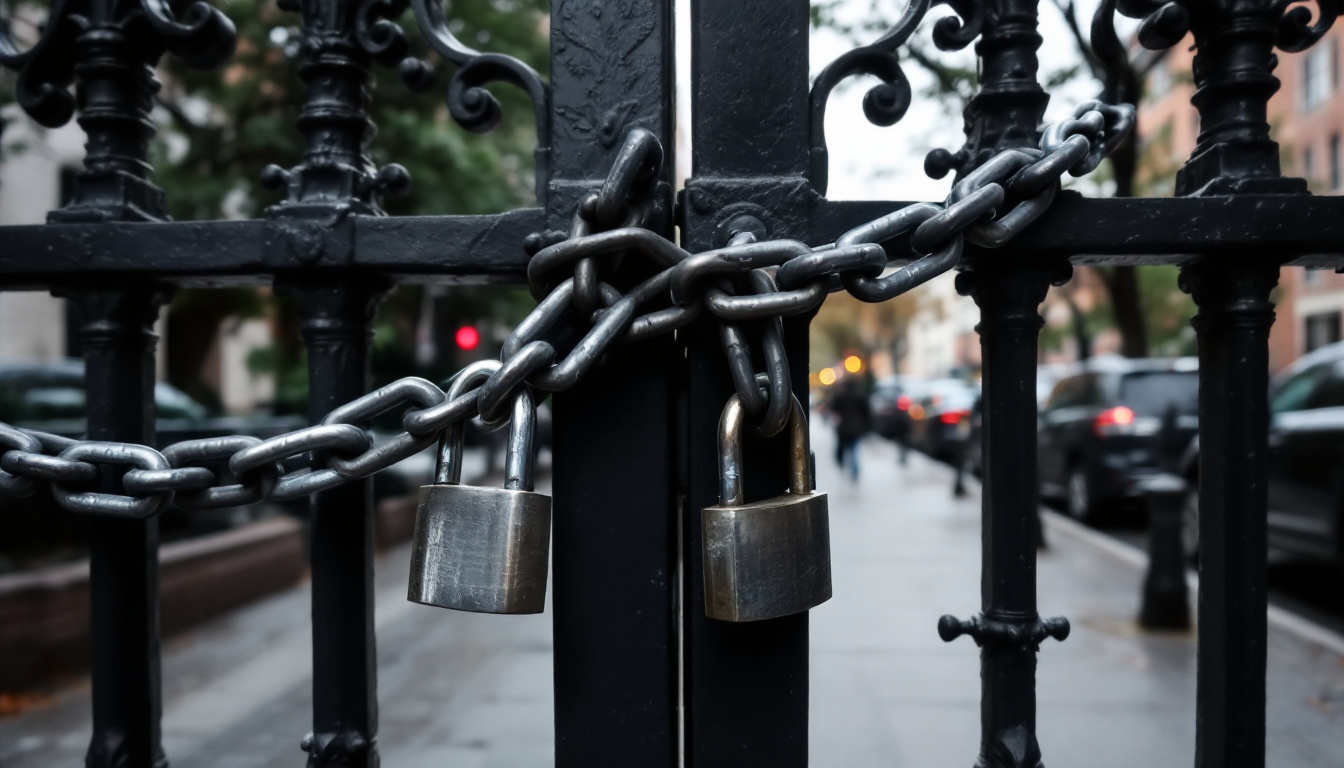
The stretch of 116th Street between Broadway and Amsterdam Avenue — College Walk — has been open to every pedestrian in New York City since at least 1953, when the city sold it to Columbia University with a legal easement guaranteeing public access. Elderly neighbors used it to get to the pharmacy. Kids walked through it on the way to the park. It was, for seventy years, a sidewalk.
Then Columbia locked the gates and hasn't opened them for three years.
The original excuse was pro-Hamas protests in October 2023. Agitators occupied Hamilton Hall, intimidated Jewish students, and turned the Morningside Heights campus into a scene that looked more like a Hezbollah rally than a quad. The university's response wasn't to expel the radicals, arrest the trespassers, or enforce a single rule. It was to chain the gates shut — for everyone.
Three years later, the chains are still on. Residents without a Columbia ID have to walk around the entire campus to get where they're going. For elderly and disabled neighbors, that's not an inconvenience — it's a barrier that has, in some cases, confined people to their homes when alternative routes aren't physically manageable. Small businesses in the surrounding blocks have watched foot traffic evaporate.
State Sen. Cordell Cleare put it plainly at a rally on the first day of fall classes, September 8: "These gates represent more than just access. It's about democracy." Assemblyman Jordan Wright was less diplomatic. "I've had enough of the excuses," he said. Victor Edwards, chair of Manhattan Community Board 9, and NYC Councilmember Shaun Abreu joined the chorus, with Abreu pointing out that Columbia operated with open, safe campuses for over a century before someone decided that gates were easier than discipline.
New university president Jennifer L. Mnookin announced what Columbia apparently considers a bold step forward: students and staff may now register up to five same-day guests, increased from a previous limit of two. A temporary "Access Service Kiosk" will be staffed at the 116th Street and Broadway gate starting in October. Columbia also released a neighborhood access form for nonaffiliates who live nearby to apply — apply — to use the street the city legally guaranteed them the right to walk on in 1953.
More than 100 residents and local programs serving children and the elderly have received campus access through a QR code system. Out of tens of thousands of neighbors. The gates still require Columbia ID with two taps, at least two security officers monitor each narrow entry point, and the hours run 7 a.m. to 7 p.m. on weekdays only.
The keffiyeh crowd, meanwhile, continues to operate freely. The protests that triggered the lockdown haven't stopped — they've become a permanent campus feature. Columbia's calculation is transparent: confronting radical students risks bad press, faculty revolts, and donor headaches. Locking out the neighborhood risks nothing, because grandmothers in Morningside Heights don't have PR firms.
Alexia Massoud, writing in the West Side Rag on September 20, captured the absurdity. She used to visit campus freely with her mother, a Columbia graduate student in the late 1990s, exploring buildings and neighborhood shops. That Columbia is gone. The university's own mission statement claims it exists to "recognize the importance of its location in New York City" and connect to "the vast resources of a great metropolis." Recognizing that importance now requires a QR code, a background check, and a willingness to be herded through a checkpoint.
An Ivy League institution that charges $65,000 a year in tuition can't figure out how to keep a sidewalk open and discipline students who break the law at the same time. Every other university in America manages it. Columbia's peer institutions managed it during the same protest wave.
The 1953 easement is still on the books. The gates are still locked. The protesters are still there.